
KR HR & TRAINING NEWS ARTICLES
Domestic Abuse Awareness Month: October 2025
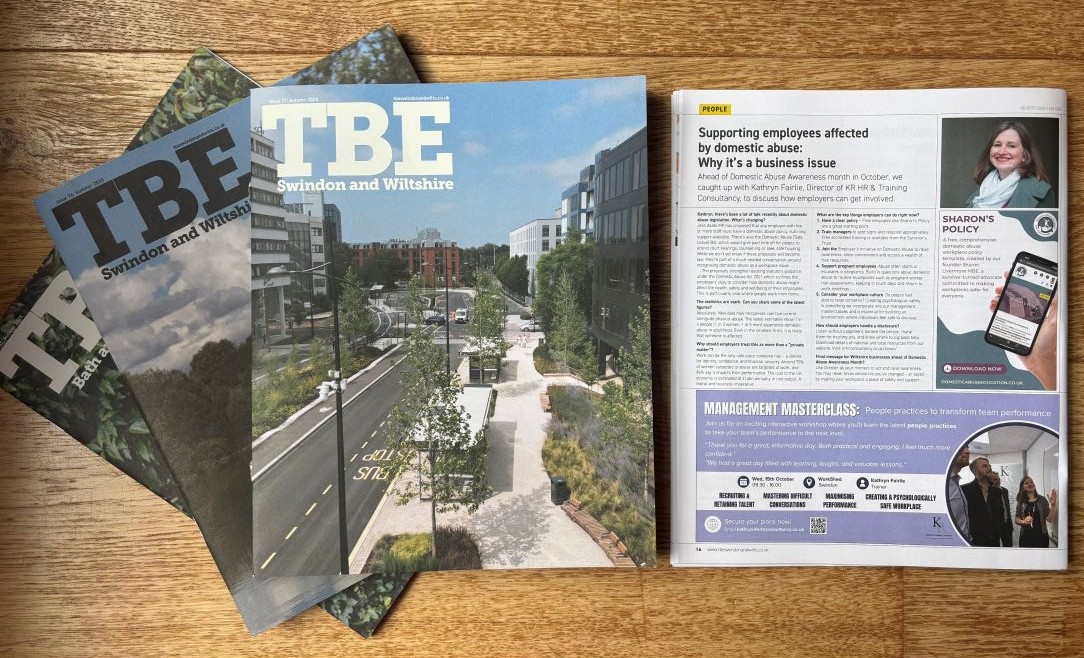
Read our interview in The Business Exchange magazine and take action to support individuals subjected to abuse.
October is recognised as Domestic Abuse Awareness Month in the UK, serving as an opportunity to raise awareness, share information, and join together to end domestic violence and abuse. This October, we are encouraging employers to seize the opportunity to take action in your workplace.
The statistics on the number of people impacted by domestic abuse are stark. The latest estimates show 1 in 4 people (1 in 3 women, 1 in 5 men) experience domestic abuse in adulthood. These numbers may be higher than you have seen before. This is because the data, taken from the Crime Survey for England and Wales, now recognises coercive control alongside physical abuse. Whilst coercive control has been unlawful since 2015, it was only incorporated into the crime survey questions earlier in 2025.
Figures of this scale mean that even in the smallest firms, it is likely that someone is affected. Every workplace, every friendship group, every extended family.
Our director, Kathryn Fairlie, was interviewed for the Autumn 2025 edition of The Business Exchange Swindon & Wiltshire magazine about why domestic abuse is a business issue. Turn to page 16 of the magazine to read the interview. We are grateful to the team at The Business Exchange for helping us to amplify our message on this important issue.
The interview includes five steps that you can take during October to make your workplace a safer space for people subjected to domestic abuse. The five steps include:
- Have a clear policy – Free templates like Sharon’s Policy are a great starting point. This may need adapting to your specific circumstances. For example, if you have employees who work from home, consider how you fulfil your duty to provide a safe working environment. It is a good idea to include a question about domestic abuse concerns in your workstation risk assessments for homeworkers.
- Train managers to spot signs of abuse and respond appropriately. Free accredited training is available from the Survivor’s Trust.
- Join the Employer’s Initiative on Domestic Abuse to raise awareness, show commitment and access a wealth of resources. Membership is free.
- Support pregnant employees. Abuse often starts or escalates in pregnancy. Build in questions about domestic abuse to routine touchpoints such as pregnant worker risk assessments, keeping in touch days and return to work meetings. A new guide promoting stronger protections in the workplace for pregnant employees facing domestic abuse is available from Domestic Abuse Education.
- Consider your workplace culture. Do people feel able to raise concerns? Creating psychological safety is something we incorporate into our management masterclasses and is essential for building an environment where individuals feel safe to disclose. Our next course is on 15th October 2025 at the Workshed in Swindon.
Kathryn comments: “Home should be your safe place. For many people, it simply isn’t. What should be their safe place, their safe person, is a source of fear, intimidation and control. Abuse doesn’t stop when an individual walks out of their front door. Online abuse, telephone calls or messages, stalking, unwanted visits to the workplace, restricting access to finances – there are many ways in which individuals continue to be affected, including when they are at work.”
According to a recent survey, around 75% of women subjected to abuse are targeted at work, and 86% say it impacts their performance. The cost to UK employers of domestic abuse is estimated at £14bn annually in lost output and reduced productivity.
Kathryn adds: “Whilst the majority of domestic abuse victims are female, men are also affected and this should not be forgotten in a workplace response. Over recent months, we have helped our clients to support both male and female victims of domestic abuse, including those experiencing post-separation abuse, stalking and economic abuse. Support has included individual responses such as listening to concerns, signposting to relevant agencies and providing access to a safe and confidential space to make telephone calls to access help, together with organisational responses including arranging accredited training with the Survivor’s Trust, implementing policies and discussing how to create a psychologically safe workplace culture where people feel able to disclose concerns.”
If you are worried about individuals in your workplace, download our free guide listing local and national helplines, charities and resources found below.
Above all, we hope that you use October as your moment to act. You may not know whose life you’ve changed – or saved – by making your workplace a place of safety and support.
If you would like any tailored support or training on this issue, please get in touch.
Download – Domestic Abuse Resources